
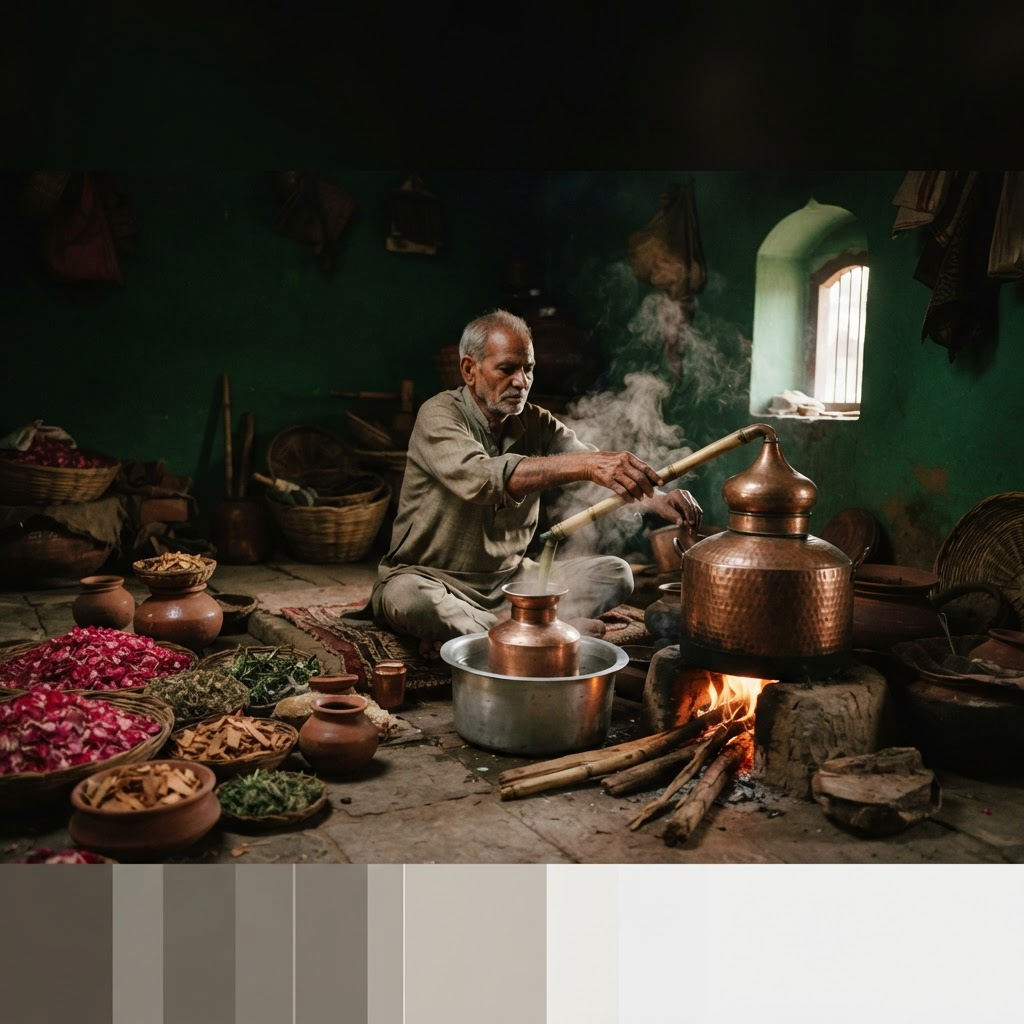
The smell people associate with the first rain is difficult to name because it is not one single material. It may recall dry ground releasing an earthy note, the mineral warmth of baked clay, green plants, dust and the atmosphere after a storm. Mitti Attar gives that experience a traditional perfumery form. It does not contain rainwater; it is a distilled fragrance associated with baked earth and the memory of rain.
What is Mitti Attar?
Mitti Attar is a traditional fragrance associated with Kannauj perfumery. In the commonly described process, pieces of prepared and baked earthen material are placed in a water-based distillation system. Aromatic material carried by vapour is directed into a receiving medium, traditionally sandalwood oil in many attar practices.
The phrase Kannauj Mitti Attar therefore describes both a fragrance idea and a craft context. The final smell is not simply “clay oil”. It is a combination of the baked-earth character, the distillation conditions, the receiving oil and the judgement of the perfumer. Practices can vary between makers and materials.
From clay to fragrance
The traditional concept can be understood as a careful sequence rather than a recipe with one universal specification. Earth or clay is prepared and baked, then broken or arranged for the still. The material is loaded into the heated vessel with water, where heat creates vapour that carries volatile aromatic material.
That vapour travels through the apparatus toward a receiver containing sandalwood oil or another appropriate receiving medium. As the vapour cools, the aromatic fraction is transferred into the oil. Repeated distillation and patient handling may be used depending on the material and desired character; exact quantities, temperatures and cycles are not identical for every workshop.
- Prepare and bake the earthen material.
- Load the prepared material into the traditional distillation apparatus.
- Heat water so vapour can carry aromatic material.
- Direct the vapour into the receiving oil.
- Allow the aromatic character to become incorporated into the attar.
- Handle and mature the result according to the maker’s practice.
Why does Mitti Attar smell like earth?
Its sensory profile is often described through dry earth, warm clay, mineral nuances, woody undertones and, in some interpretations, a smoky or baked edge. These are useful ways to communicate an experience, not laboratory claims about a single chemical identity.
Petrichor is a scientific term associated with the characteristic earthy smell noticed after rainfall. Mitti Attar is not chemically identical to petrichor and does not literally reproduce every smell present outdoors after rain. It is a traditional distilled interpretation of baked earth that becomes linked, through memory and association, with rainfall.
The role of sandalwood
Sandalwood oil has traditionally served as an important base or receiving medium in many Indian attars. Its soft, woody character gives the distillate a lasting oil phase in which aromatic material can be carried. It also changes the final sensory balance: the finished fragrance is an interaction between the incoming material and the sandalwood base.
This is why describing Mitti Attar as “clay” alone is incomplete. The receiving oil, the apparatus, the heat, the raw material and the perfumer’s handling all contribute to the result. Not every modern fragrance using an earthy idea follows this traditional structure.
Mitti Attar and Kannauj
Kannauj is strongly associated with traditional Indian perfumery, including attar, floral distillation and natural aromatic materials. The Deg-Bhapka apparatus is central to how this craft is explained: a heated vessel, vapour movement, condensation and a receiving medium work together as an integrated system.
The heritage value of Mitti Attar lies in this connection between material and method. Baked earth becomes a subject for sensory knowledge, while the workshop preserves decisions that cannot be reduced to a label: how the material is prepared, how heat is judged, and when the fragrance is considered ready.
How to understand its fragrance
A first impression may suggest dry ground or warm clay. As the scent settles, sandalwood can bring a rounded woody base, while mineral, smoky or dusty nuances may appear depending on the material and distillation. These descriptions are intentionally sensory; individual perception and formulation can differ.
Modern perfumery has also explored rain, soil and petrichor as creative themes. Those compositions may use aroma molecules, extracts or other bases and should not be confused with traditional attar simply because they share an earthy subject.
Frequently asked questions
What is Mitti Attar?
A traditional fragrance associated with baked earth and rain-soaked ground, made through water-based distillation into a receiving oil.
Is Mitti Attar made from rainwater?
No. The rain association describes its sensory memory; traditional descriptions focus on baked clay or earth, water, vapour and receiving oil.
What is the Deg-Bhapka method?
A traditional distillation arrangement in which aromatic material and water are heated in a deg and vapour is directed toward a bhapka or receiver.
Why is sandalwood used?
Sandalwood oil can act as a woody receiving and carrying medium in many traditional attars, though practices vary.
Is Mitti Attar the same as petrichor?
No. Petrichor describes an earthy smell associated with rainfall; Mitti Attar is a traditional distilled fragrance inspired by baked earth.
Why is Kannauj associated with it?
Kannauj is a major reference point for Indian attar and distillation traditions, including fragrances associated with natural aromatic materials.
Sources & references
FFDC Kannauj public material on traditional attar and Mitti Attar; consult the original institutional record for technical claims.
This is an educational article. Terminology and workshop practice can vary; source status is shown openly.