
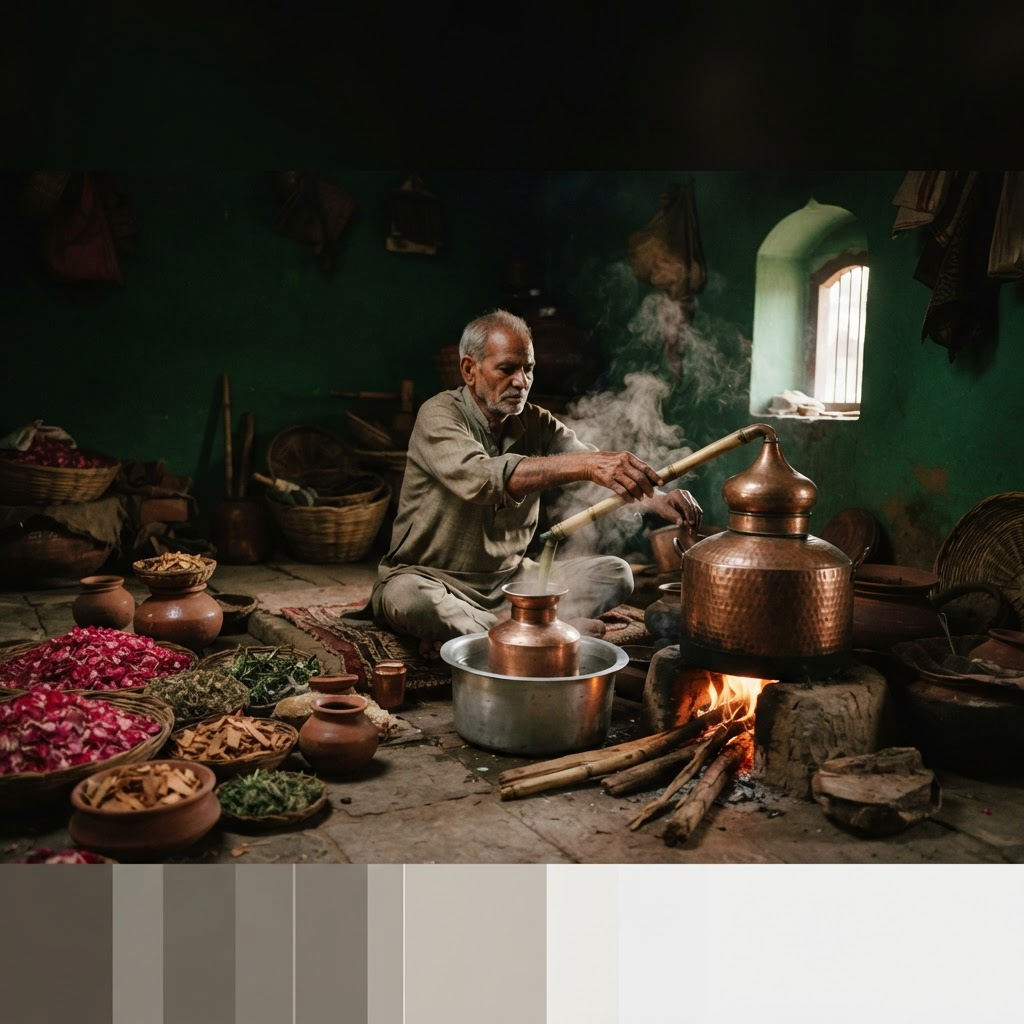
Indian perfumery uses a vocabulary shaped by materials, extraction methods, regional practice and trade. Ruh, attar, ittar, deg, bhapka, mitti and shamama do not all name the same thing. They are clues to how a fragrance is prepared, understood and passed between makers and readers.
What does “Ruh” mean?
Ruh is commonly used in Indian perfumery for a concentrated distilled aromatic material or essence, often associated with a floral or botanical source. Ruh Gulab, for example, refers to a rose distillate tradition. The word should not be treated as one rigid definition that applies identically to every material, region or market.
A useful working distinction is that ruh often points toward the aromatic essence or distillate itself, while the word attar often points toward a traditional perfume material made by distilling aromatic material into a base oil. In actual trade, usage can overlap.
What is attar?
Attar, also written ittar in many South Asian contexts, commonly describes a traditional perfume material produced through distillation, often into sandalwood oil or another receiving base. Kannauj is closely associated with this practice and with the Deg-Bhapka system used to explain it.
Attar is therefore not simply a synonym for every essential oil. It describes a craft and a material form whose identity depends on the aromatic source, the receiving medium and the method. Terminology varies, so careful writing should state the context rather than force a universal definition.
Ruh vs Attar
The comparison below is intentionally general. A perfumer or source may use the terms differently, and the distinction can shift according to the material being discussed.
- Ruh · a distilled aromatic material or concentrated essence in certain Indian perfumery contexts; often floral or botanical.
- Attar · a traditional perfume material produced through distillation into a base oil; strongly associated with Kannauj and wider Indian perfumery.
- Itr / Ittar · a spelling and usage form often used interchangeably with attar in everyday trade, while individual sources may distinguish them.
Ruh Gulab
Ruh Gulab is commonly understood through rose distillation. Rose petals are combined with water in a distillation system; aromatic vapour travels through the apparatus, condenses and is collected as a concentrated rose aromatic material. The exact practice and terminology should be documented for the maker or source being described.
Rose essential oil and rose-based attar terminology are related but not automatically identical. A rose material may be described by its extraction method, its receiving medium or its trade vocabulary. Avoid inventing ratios or treating one workshop’s method as universal.
How traditional attar is made
A simplified overview is: raw material → water → deg → heat → vapour → bhapka → condensation → receiving oil → traditional attar. The Deg-Bhapka page explains the apparatus in more detail. This sequence is a conceptual map; real practice varies with the material, equipment and perfumer.
Why terminology matters
Fragrance vocabulary preserves decisions about craft. It can tell a researcher whether a source is discussing a material, a preparation, a vessel, a distillation method or a finished perfume. It also helps students read historical and technical records without flattening every fragrance into the modern category of “perfume”.
For Kannauj, language connects floral distillation, natural aromatic materials, family workshops, attar and the sensory knowledge of perfumers. Learning the terms is a way of learning how the craft thinks.
A small working glossary
Ruh: a concentrated distilled aromatic essence in certain contexts. Attar: a traditional distilled perfume material. Itr: a common spelling variant or related trade term. Deg: heated distillation vessel. Bhapka: receiving or condensing vessel. Mitti Attar: an attar associated with baked earth and rain memory. Shamama: a complex traditional botanical perfume form. Sandalwood oil: a traditional receiving or base medium in many attars. Hydro-distillation: distillation using water, heat, vapour and condensation.
Frequently asked questions
What is Ruh?
A term commonly used for a concentrated distilled aromatic essence in Indian perfumery, with usage varying by material and region.
What is Attar?
A traditional perfume material made through distillation, often into a receiving base such as sandalwood oil.
What is the difference between Ruh and Attar?
Ruh often points to a distilled essence, while attar often points to a finished traditional perfume material in a base oil; usage overlaps.
What is Ruh Gulab?
A rose distillate tradition associated with the distillation of rose petals and water.
Is Ruh the same as essential oil?
Not necessarily. The terms come from different craft and trade contexts and should be defined for the material and source in question.
What is Itr?
A spelling and trade term related to attar, often used interchangeably in everyday South Asian fragrance contexts.
Why is Kannauj associated with attar?
Kannauj is a major reference point for traditional Indian perfumery, attar production and natural-material distillation.
Sources & references
FFDC Kannauj public material and institutional references on traditional attar and distillation; terminology can vary and should be checked against the cited source.
This is an educational article. Terminology and workshop practice can vary; source status is shown openly.