
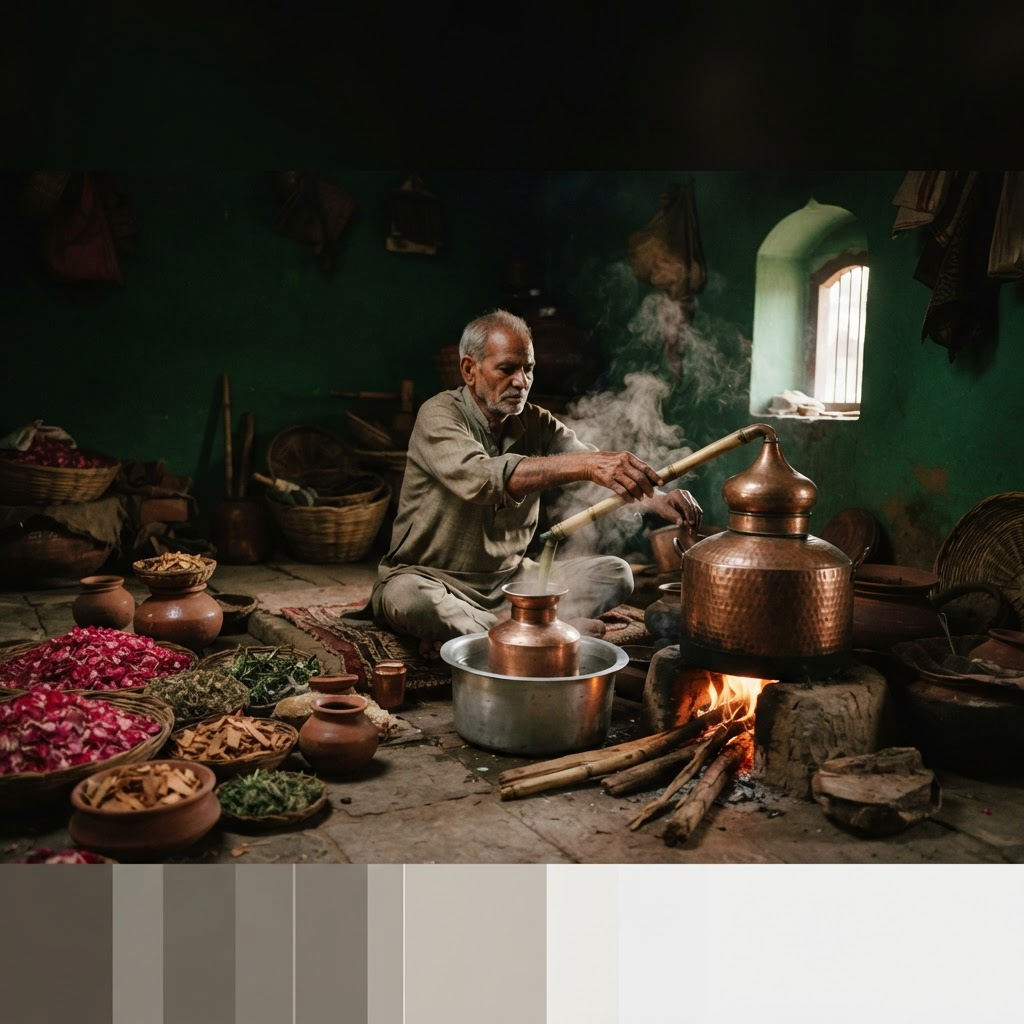
Traditional attar making is not simply the mixing of fragrant liquids. It is a distillation craft in which aromatic raw materials, water, heat, vapour, condensation and a receiving medium are managed together. The Deg-Bhapka system gives this work a physical language: copper vessels, joined connections, a cooling receiver and the patient attention of the perfumer.
What is Deg-Bhapka?
Deg-Bhapka is the name commonly used for the traditional distillation arrangement associated with Kannauj perfumery. A deg is the heated vessel that holds water and aromatic material. The bhapka is the receiving or condensing vessel toward which vapour is directed. Terminology can vary in trade and regional practice, so the apparatus should be described by its function as well as its name.
The method uses heat to move volatile aromatic material with steam. When the vapour cools, the aromatic fraction is collected in a receiving medium, often sandalwood oil in traditional attar production.
How the process works
The sequence below is a teaching model, not a claim that every workshop uses identical conditions or the same number of cycles. Raw materials differ, and experienced perfumers adapt handling to the material and the intended fragrance.
- 01 · Prepare the aromatic material according to its botanical or material character.
- 02 · Load the material into the deg.
- 03 · Add water to support water-based distillation.
- 04 · Apply controlled heat rather than treating high heat as automatically better.
- 05 · Let steam carry volatile aromatic compounds.
- 06 · Guide vapour toward the bhapka.
- 07 · Allow cooling and condensation.
- 08 · Collect the aromatic distillate in the receiving oil or medium.
- 09 · Repeat only where the material and maker’s practice call for it.
- 10 · Rest and handle the finished attar appropriately.
Why copper?
Copper equipment is part of the visual and material identity of traditional distillation in Kannauj. Its importance should not be reduced to the claim that copper alone creates the fragrance. The apparatus provides a durable vessel and a familiar way to manage heat, water, vapour and connections within a workshop practice.
What matters most is the relationship between equipment and knowledge: how a perfumer reads the material, adjusts the fire, notices vapour flow and judges the developing smell.
The role of fire
Fire is the energy source for distillation, but controlled heating is the craft. Too little heat may not sustain the movement of vapour; too much can disturb delicate aromatic material or change the balance of a distillate. Traditional makers learn this through observation, timing and repeated work rather than a single universal temperature.
The process can also be explained scientifically as hydro-distillation or steam-assisted transfer. Volatile compounds move with vapour, then condense and partition into an oil phase. Practical perfumery adds sensory judgement to those physical principles.
The Bhapka and condensation
In simple terms, the deg is heated, steam and vapour rise, and the bhapka receives the vapour so it can cool. The condensed material is collected in a receiving medium. The path can be represented as: DEG → HEAT → STEAM / VAPOUR → BHAPKA → CONDENSATION → RECEIVING OIL → ATTAR.
Sandalwood oil has traditionally been used as the receiving medium for many attars because it offers a stable, woody oil base. It is not universal: practices vary by attar, raw material and formulation.
Craft knowledge and Kannauj
A perfumer manages raw-material quality, water, heat, timing, vapour flow, condensation, receiving oil, repetition and maturation. None of these variables can be safely replaced by a generic numerical specification. This is why the Deg-Bhapka matters as living knowledge rather than as an antique object alone.
In Kannauj, the method connects workshop practice with a wider fragrance vocabulary: attar, ruh, mitti, floral distillation and natural materials. Its continuity depends on documentation, skilled practitioners and responsible interpretation.
Frequently asked questions
What is Deg-Bhapka?
It is a traditional distillation arrangement associated with Indian perfumery, including a heated deg and receiving bhapka.
What is a deg?
The heated vessel used to hold aromatic material and water in traditional descriptions of the still.
What is a bhapka?
The receiving or condensing vessel toward which aromatic vapour is directed.
Why is copper used?
Copper is part of the traditional apparatus and supports durable workshop practice; it should not be described as the sole source of fragrance.
What is the role of heat?
Heat supplies the energy needed to create vapour and must be controlled to protect the material and guide the process.
Why is sandalwood oil used?
It can serve as a traditional receiving and carrying medium, although not every attar uses it.
Is it still used in Kannauj?
Deg-Bhapka remains an important reference in accounts of Kannauj perfumery; current practice should be confirmed with documented makers or institutions.
Sources & references
FFDC Kannauj public material describing traditional attar and Deg-Bhapka processing; consult the original institutional record for process-specific claims.
This is an educational article. Terminology and workshop practice can vary; source status is shown openly.